
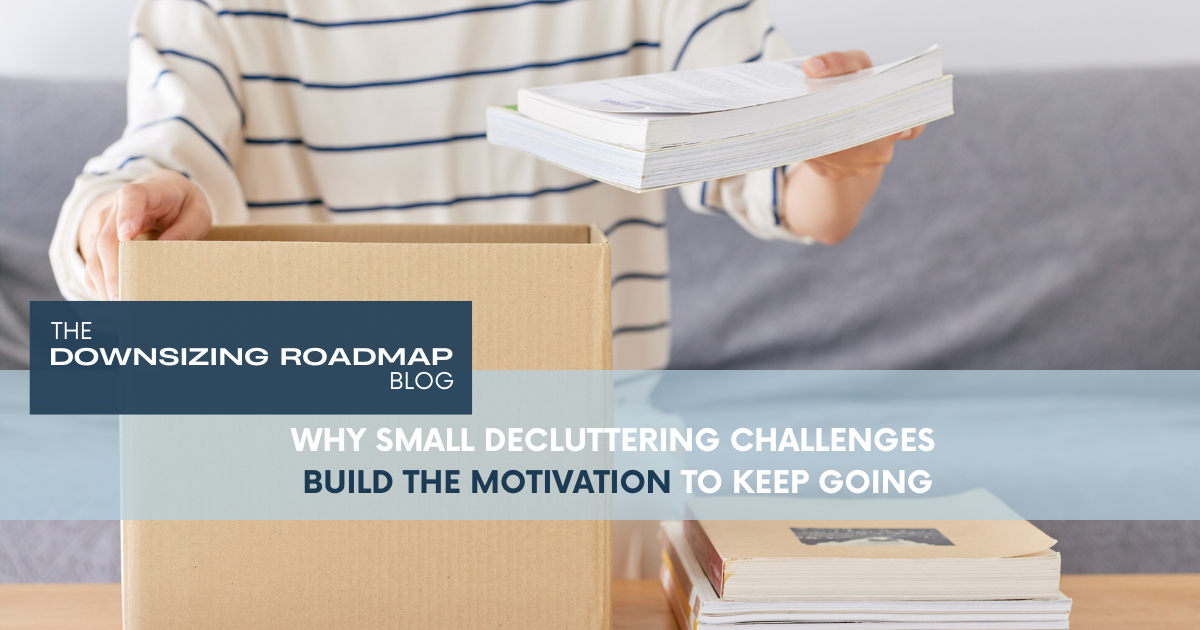
Small decluttering challenges build real motivation and momentum because they give you a structure to follow. Willpower alone isn’t enough when the overall project feels this big. Most clients who come to us aren’t stuck because they don’t care about getting the house sorted. They’re stuck because the size of the overall project makes it impossible to know where to start. Without a clear starting point, nothing moves.
A short, defined challenge changes that. It removes the decision fatigue from the front end of the process. You get a specific task with a finish line you can actually reach.That combination is what produces the forward motion that makes the rest of the project feel possible.
Why Do Decluttering Challenges Work When General Motivation Doesn’t?
General motivation is unreliable. It shows up when you’re feeling energized and disappears when you’re tired or emotionally weighed down by what you’re looking at. What we see consistently is that the people who make the most steady progress aren’t always the most motivated. They’re the ones who have a structure in place that carries them through the days when motivation isn’t there.
A challenge works because it takes the decision out of your hands in the best possible way. You already know what the task is and what done looks like, instead of waking up and asking yourself whether you feel like it today.That specificity is what gets people started, and starting is the hardest part of almost every session.
Additionally, a challenge with a defined endpoint gives you something to complete rather than something to maintain. Seven days, five tasks, one room — the form matters less than having a finish line. Completion matters more than consistency in the early stages, because it builds the internal evidence that you follow through on this. That evidence is what real momentum is made of.
What Makes a Small Decluttering Challenge Actually Effective?
Not all challenges are built the same way, and the ones that don’t work tend to fail for the same reason. They start too big. When the first task requires sorting an entire room or a full Saturday on the house, the challenge becomes another version of the overwhelming project you were already avoiding.The bar has to be low enough that you genuinely cannot talk yourself out of it.
What we tell clients is that an effective challenge has three things going for it. First, each task is small enough to finish in one sitting, ideally twenty to thirty minutes. Second, the task has a clear boundary — a single drawer, one surface, one category of items — so you know when you’re done. Third, the tasks build on each other in a way that produces visible progress without front-loading the hardest decisions.
Sentimental items and anything with significant emotional weight should come later in the challenge, not at the beginning. Starting with lower-stakes practical areas gives you a string of completions before reaching the places that take more emotional energy to work through. By the time you get to those harder decisions, you’ve already proven to yourself that the process works.
How Does a Short Challenge Connect to a Bigger Downsizing Plan?
The question we’d want every client to hold onto as they work through any kind of structured challenge is this one. A challenge is a starting mechanism, not a finish line. Seven days of focused tasks can clear real space and give you enough momentum to keep going. However, the challenge needs to connect to something larger to actually carry you through a full downsizing move.
What we work on with clients is building that bridge between early action and a real plan. The transition from doing small tasks to making real decisions about the house and the timeline is where a lot of people stall, even after a strong start. Our 5-Step Roadmap — Dream It, Decide It, Release It, Refresh It, and Live It — is built around exactly this sequence. A challenge lives inside the Release It phase, but it works best when the Dream It and Decide It work has already happened. That way, the decisions you make in each session connect to a direction you’ve already chosen.
If you’ve completed a challenge but still feel uncertain about where the bigger project is headed, that’s the right moment to step back and map it out. You can start with our Free Downsizing Guide at https://downsizingroadmap.com/guide/ or reach out directly at https://downsizingroadmap.com/help/ to talk through where you are.
We share more of what we see with clients every week on our Facebook page: https://www.facebook.com/downsizingroadmap/
What Happens to Motivation After the Challenge Ends?
This is worth addressing directly because it’s something we hear from clients regularly. You finish the challenge feeling good, the space looks better, and then a week goes by without much happening. That experience can feel like failure, but it isn’t. It means the challenge did its job and now the next structure needs to take over.
The goal of a short challenge is to move you from not started to started. It gives you enough real evidence of your own capability that the next step feels reachable. After the challenge, look at what you did, notice what felt manageable, and use that information to build the next phase of the project. Some clients take that on independently. Others come to us at that point because they want to make sure the momentum connects to a clear plan and a real timeline for the move.
Either way, the challenge worked. Progress happened. That’s exactly what it was there to do.
Frequently Asked Questions
How do I choose the right challenge to start with if I’ve never done this before?
Start with something short enough that you can finish it this week. Five tasks over five days or seven tasks over seven days both work well. The most important thing is that each individual task is small enough to complete in one sitting without requiring difficult decisions. A junk drawer, a kitchen counter, a shelf in the bathroom cabinet — those are the right starting places. Save the hard stuff for later in the challenge once you’ve built some traction.
What if I miss a day or fall behind?
Keep going from wherever you left off, without adding extra tasks to make up for the gap. The value of the challenge isn’t in completing it perfectly. It’s in completing it. Picking back up the next day without guilt is part of the skill you’re building. The full downsizing project will have interruptions too, and knowing how to re-enter without losing your footing matters.
Can a challenge work when the emotional weight of the belongings is really heavy?
Yes, but the structure matters more in that situation, not less. When belongings carry significant emotional weight, having a clear and small task in front of you removes the pressure of deciding how you feel about everything at once. We recommend starting with practical, lower-stakes areas and leaving sentimental items for sessions when you have more time, more energy, and ideally some support around you. A challenge can move through emotional territory — it just needs to pace it well.
I’ve tried challenges before and they didn’t stick. What’s different about using one as part of a downsizing plan?
The difference is usually context. A standalone challenge can produce a burst of progress that fades because there’s no larger plan for it to connect to. When a challenge is the entry point into a structured downsizing process, the momentum it builds has somewhere to go. The progress carries forward because each completed task is part of a sequence that leads somewhere specific.
When is the right time to move from a challenge into working with someone directly?
When you’ve made some progress on your own and want to make sure the rest of the project is moving in the right direction, that’s usually the right time. Most clients who come to us have already started. They’ve sorted some things, cleared some space, and now they want a clear plan for what comes next and confidence that their decisions are the right ones. Ready for help? Reach out at https://downsizingroadmap.com/help/
If you’re thinking about downsizing and want a clear place to start, you can begin with our Free Downsizing Guide: https://downsizingroadmap.com/guide/
The Downsizing Roadmap Podcast is also a great place to start if you prefer to learn by listening:https://downsizingroadmap.com/downsizing-roadmap-podcast/
We share ongoing insights on our Facebook page: https://www.facebook.com/downsizingroadmap/
You’re also welcome inside our private Facebook group, Downsizing & Decluttering Community | Simplify Your Next Chapter, where people ask questions and share experiences: https://www.facebook.com/groups/456269625127772
And if you’re ready to talk through your situation, reach out here: https://downsizingroadmap.com/help/
Jodi Rosko and Heather Fisher and Downsizing Roadmap work with clients every day to help them move through downsizing with a clear plan, so progress can happen without creating more stress along the way.