
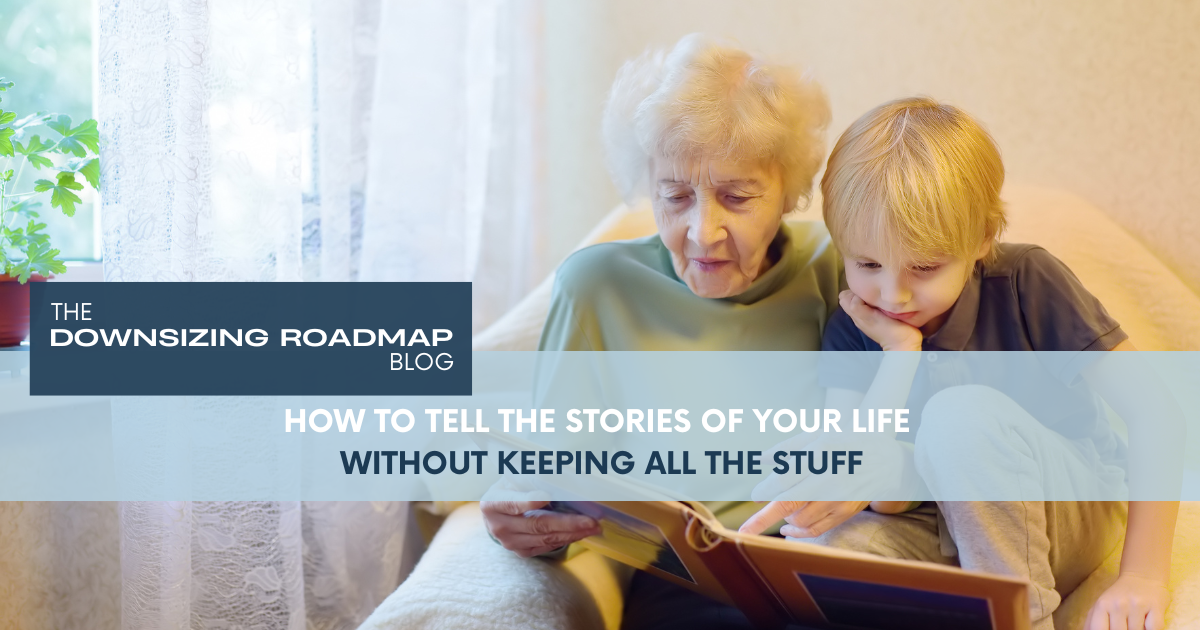
Telling the stories of your life does not require keeping everything you own. The meaning behind your belongings lives in the experiences surrounding them. With the right approach, that meaning can outlast the objects themselves by decades.
One of the most common things we hear from clients is this: “My kids don’t want my stuff.” Underneath those words sits a quieter fear. If no one wants it, does the story disappear with the item? What we know from working with hundreds of families is that the story and the object are not the same thing. Objects store your stories temporarily. Your job during a downsize is to give those stories a permanent home somewhere else.
Why does letting go feel like losing the story itself?
Most people enter a downsize treating two very different questions as one. “What do I want to keep?” and “What do I want to remember?” both feel urgent at the same time. They require completely separate decisions, though. When clients collapse those two questions together, the whole process stalls. They hold onto more than their new space allows, and they still feel like something important slipped away.
Objects carry emotional weight because of the experiences connected to them. Your grandmother’s sewing box matters because of her hands using it, the sound of her voice, and what Saturday afternoons at her house felt like when you were young. Without that context documented somewhere, the sewing box holds the meaning hostage. Document the context first, and releasing the box becomes something you can actually do.
What shifts when you focus on the story instead of the stuff?
This reframe changes the entire experience of downsizing for most of our clients. Rather than asking whether you can let something go, we encourage people to ask whether the story has been captured yet. That question gives you something concrete to do before an item leaves your hands. It moves the process forward rather than freezing it.
We explored this dynamic on The Downsizing Roadmap Podcast, and the listener response confirmed what we see in our work every week. People are not struggling to release physical objects. They are struggling to release what those objects represent. Once that meaning has a home outside the object, letting the physical item go becomes far more manageable.
How do you tell the stories of your life without creating more piles?
Several approaches work well, and the right one depends on how you naturally communicate.
Recording short videos on your phone requires nothing more than willingness. Hold the item, look at the camera, and talk through the story behind it in your own words. A three-minute video of you explaining your father’s pocket watch carries more emotional weight than the watch alone. That video lives on a phone, gets shared in a family group text, and gets watched far more often than a box in storage ever gets opened.
Writing a one-page story for a meaningful item works especially well for clients who process through writing. The page does not need to be literary or long, just honest. Cover three things: where this came from, what it was present for, and why it mattered to you. Tuck that page into a scrapbook or save it in a shared digital folder your family can access.
Digitizing photographs, letters, and handwritten cards removes storage anxiety without erasing the archive. Services like Legacybox and ScanMyPhotos handle large batches at an accessible price. The result is a shareable library your whole family can reach from any device. Scanning one shoebox of old photographs takes an afternoon and tends to release more anxiety than keeping the box ever did.
Memory platforms like StoryWorth send weekly prompts by email and compile answers into a printed book at year’s end. The work happens in small increments over time. Several clients have told us that finishing this process made releasing physical belongings easier than they expected. You can also connect with others navigating the same transition in our Downsizing and Decluttering Community on Facebook.
What do you do when no one in the family wants the heirlooms?
We tell clients the honest truth: the value you placed on something does not depend on whether someone else inherits it. Your children declining the china set does not erase what that china represented at your table for thirty years. It simply means the story needs a different home than a cabinet in someone else’s house.
Donating to organizations that will actively use items tends to feel more meaningful than clients expect. Historical societies sometimes accept documented pieces with clear provenance. Estate sales and antique dealers move belongings toward people who will genuinely appreciate them. Knowing that an item continues somewhere often makes the transfer feel like a handoff rather than a loss.
Which small habits actually move the storytelling process off the to-do list?
The most common reason this work stays undone is that people imagine it requires a cleared calendar and a dedicated project weekend. We recommend thirty minutes once a week, one item or one story at a time. That pace builds a meaningful archive over several months without requiring a perfect setup to begin.
Calling a sibling or cousin to ask what they remember about a specific object frequently surfaces stories you had forgotten entirely. Those conversations add texture and perspective you cannot generate on your own. Sharing what you uncover before items leave also gives the process a sense of resolution. Releasing things quietly and undocumented rarely provides that same feeling.
If you are navigating this and want a structured place to start, our Free Downsizing Guide walks through the process in a way that is practical from the very first page.
FAQ: Telling the Stories of Your Life When Downsizing
What if I feel guilty letting go of something a loved one gave me?
Guilt around a gift almost always signals that the item feels tied to a relationship, not that it needs to stay in your possession. Documenting the story behind it tends to release that guilt in a way that holding the object never does. The relationship lives in you. The object was one expression of it, not the whole thing.
Do I need to document everything before anything can leave?
Trying to document everything is exactly what stalls most people, so no. Start with the ten or fifteen items that feel most emotionally loaded. Give yourself permission to release the rest without ceremony. Many things can leave without documentation and without regret. Your goal is to capture what genuinely matters, not to archive everything you have ever owned.
What if my kids change their minds later and wish they had kept something?
Taking photographs of meaningful items before they leave, and sharing those photos with your family, creates a visual record that resolves this worry for most people. Some clients keep a brief written inventory with a photo and one sentence of context for each item that moved on. That simple record tends to satisfy the “what if” feeling on all sides.
Is there a digital format for sharing family stories that people will actually engage with?
Format matters more than most people realize. Short videos shared in a family group text consistently get far more engagement than long documents sent over email. Keep each video focused on one item or one memory and under five minutes. People return to those regularly, while lengthy written letters rarely get the same attention.
How do I know what is worth documenting and what is just clutter?
When an item carries a story only you can tell, it deserves documentation before it leaves. When nothing meaningful comes to mind as you hold something, that response is useful information too. The question is not whether something looks significant to someone else. What matters is whether the story attached to it would mean something to a person who loved you.
If you’re thinking about downsizing and want a clear place to start, you can begin with our Free Downsizing Guide: https://downsizingroadmap.com/guide/
If you prefer to learn by listening, you can explore The Downsizing Roadmap Podcast: https://downsizingroadmap.com/downsizing-roadmap-podcast/
We share ongoing insights on our Facebook page: https://www.facebook.com/downsizingroadmap/
You’re also welcome inside our private Facebook group, Downsizing & Decluttering Community | Simplify Your Next Chapter, where people ask questions and share experiences: Downsizing & Decluttering for You or Your Parents | Downsizing Roadmap
And if you’re ready to talk through your situation, reach out here: https://downsizingroadmap.com/help/
Jodi Rosko and Heather Fisher and Downsizing Roadmap work with clients every day to help them move through downsizing with a clear plan, so progress can happen without creating more stress along the way.