
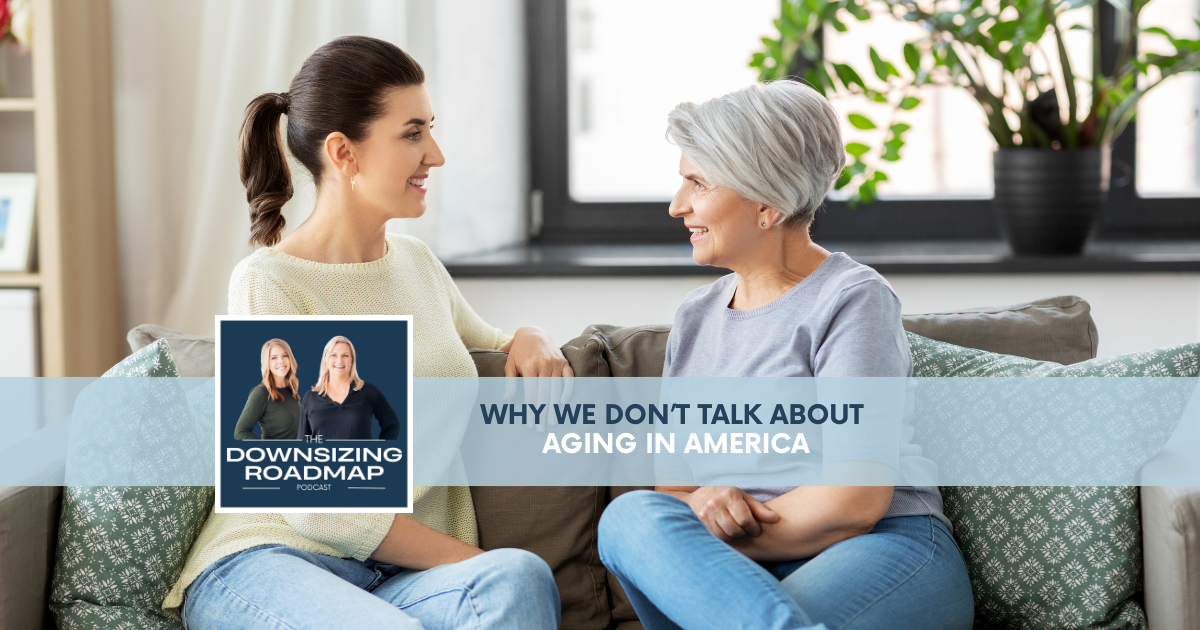
Why we don’t talk about aging in America is directly connected to how we define independence, success, and family.
In this country, independence is celebrated. We admire self-reliance. We raise children to stand on their own. However, when those values meet the realities of aging, conversations often disappear. Parents say they do not want to be a burden. Adult children say they do not want to interfere. As a result, important planning is postponed until a fall, a hospital stay, or a financial strain forces decisions.
Understanding why we don’t talk about aging in America helps families make better housing and lifestyle choices before urgency removes options.
The Cultural Roots Behind Why We Don’t Talk About Aging in America
The United States was shaped by frontier life and rugged individualism. Success was measured by what someone could build or accomplish alone. Later, industrialization and the growth of suburbs reinforced the nuclear family structure. Homes were designed for parents and children, not multi-generational living.
In 1960, 57 percent of U.S. households were married couples with children. By 2020, only 19 percent fit that model, according to the U.S. Census. The physical structure of family life changed, yet the belief in independence remained.
Because independence is so deeply valued, admitting you may need help as you age can feel like failure instead of wisdom. That mindset is a major reason why we don’t talk about aging in America until a crisis demands it.
What This Means for Aging Parents
For many older adults, independence equals identity. If I can drive myself, maintain my home, cook my meals, and manage my finances, I am still in control. Downsizing can feel like surrendering control. Moving closer to family can feel like losing freedom.
Emotionally, many parents avoid sharing health concerns because they believe it protects their children. Logically, they equate doing everything alone with staying safe. Yet many suburban homes built in the 1950s and 1960s were designed for raising children, not for aging safely. Two-story layouts, basement laundry, and exterior maintenance become physically demanding over time.
According to the CDC, approximately 60 percent of falls occur at home. Even so, families frequently avoid discussing safety modifications or downsizing until after an incident.
We see this often in our work with clients who are simply tired of managing a house. The conversation is rarely just about square footage. It is about safety, energy, and lifestyle. You can read more about that in our article on Downsizing When You’re Tired of Managing a House: https://downsizingroadmap.com/downsizing-when-youre-tired-of-managing-a-house/
What This Means for Adult Children
Adult children often live in different cities or states. Career opportunities and mobility have created geographic distance. Consequently, daily awareness of health changes or home maintenance challenges disappears.
Emotionally, children feel conflicted. They were raised to respect independence. They worry about offending their parents. Logically, they are calculating logistics and finances. If something happens, how will support work from another state? Who will coordinate care?
So the conversation gets delayed. This delay is another reason why we don’t talk about aging in America until decisions are urgent.
In many cases, families are emotionally ready for change but logistically overwhelmed. We address that challenge in Downsizing When You’re Emotionally Ready but Logistically Overwhelmed: https://downsizingroadmap.com/downsizing-emotionally-ready-logistically-overwhelmed/
What Other Cultures Teach Us About Aging
When we compare American norms to other parts of the world, the contrast is clear.
In Japan, Respect for the Aged Day is a national holiday. Elders are publicly honored, and living near or with parents is common. Dependence is normalized as part of life.
In China, the value of filial piety emphasizes adult children caring for parents. In 2013, legislation even required adult children to visit aging parents.
Across much of Latin America, multi-generational households are common. Grandparents help raise children. Later, children support parents. There is no dramatic role reversal.
In Mediterranean countries such as Italy and Greece, elders remain central to daily meals and traditions. Aging is tied to belonging and pride.
In Okinawa, one of the world’s Blue Zones, longevity is closely linked to purpose and intergenerational connection. Roughly 1 in 1,450 residents lives to 100 or older. Community and shared responsibility matter.
America does not lack love for older adults. Rather, we lack built-in systems that normalize aging conversations and shared planning.
Housing Is Often at the Center of the Aging Conversation
The suburban home that was perfect for raising children may not be ideal for aging safely. Stairs, long driveways, and high maintenance demands can become barriers to independence instead of symbols of it.
This is where housing and mindset intersect. If safety, community, and connection matter most, then the question becomes practical. Does the current home support those values long term? Would a single-level home, patio home, condo, or senior living community offer more freedom rather than less?
Talking about aging early allows families to align housing decisions with values instead of reacting to emergencies.
A Simple Framework to Start Aging Conversations
If you are unsure how to begin, keep it simple.
Start with curiosity.
“What does independence look like for you over the next ten years?”
Normalize planning.
“We do not talk about this much, but I think planning ahead matters.”
Acknowledge autonomy.
“What would support look like without taking away your freedom?”
Explore scenarios gently.
“If driving became harder, what would you want to happen? If stairs became challenging, what would feel right?”
Share your perspective.
“I want to make sure we understand what matters most to you.”
These discussions protect independence because they preserve options.
Redefining Independence in America
If we understand why we don’t talk about aging in America, we can also change it.
Independence does not have to mean isolation. Planning does not mean surrender. Asking for help does not erase strength.
For families thinking about what home works best for the years ahead, whether that involves downsizing locally or exploring options in another state, we can help evaluate those next steps. You can explore more resources and episodes on our podcast page at https://downsizingroadmap.com/podcast/
For ongoing conversations and updates around aging and downsizing, follow Downsizing Roadmap on Facebook: https://www.facebook.com/downsizingroadmap/