
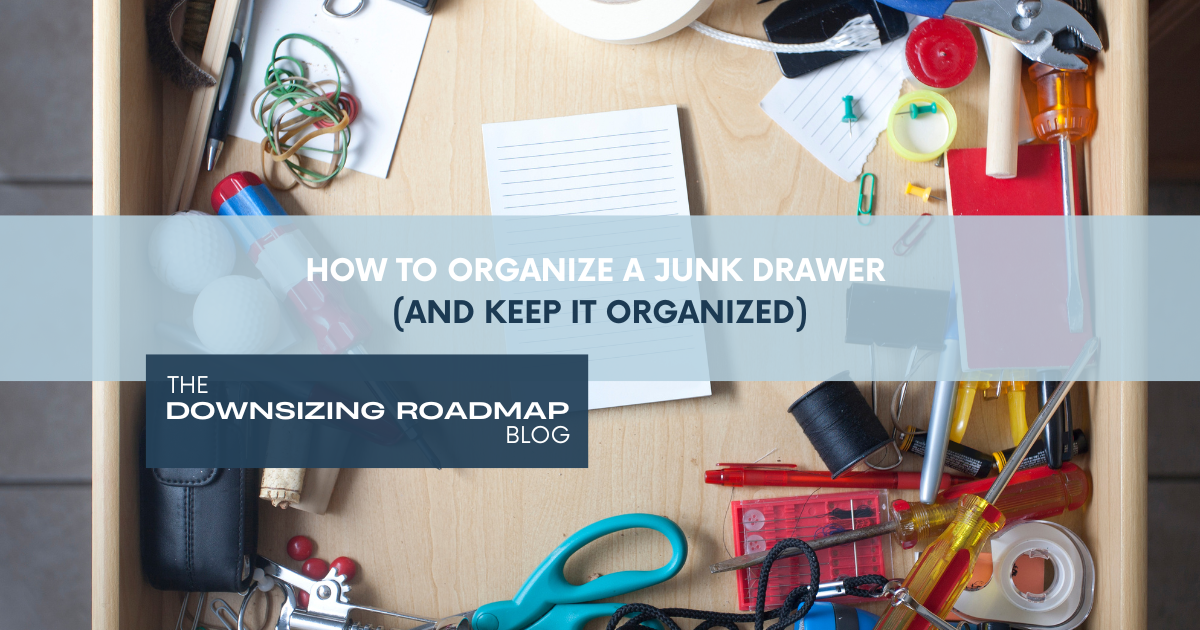
If you want to know how to organize a junk drawer, start by emptying it completely. Then sort everything into a few clear groups and keep only what you use. Give each keeper a defined spot, and the chaos turns into a drawer that actually works. We walk clients through this exact process all the time, and it goes faster than most people expect.
Why Does Your Junk Drawer Always End Up a Mess?
Your junk drawer fills up because it quietly becomes the home for everything that has no home. Batteries, takeout menus, spare keys, and tangled cables all land there by default. We see this in nearly every house we walk through, so please know it is completely normal. The problem is not that you are messy. Instead, the drawer simply absorbs the small decisions you keep postponing during a busy week.
Over time, those postponed decisions pile up fast. Each item feels harmless on its own, yet the heap grows until the drawer barely closes. Researchers at UCLA have even linked visible household clutter to higher stress levels. That is one reason a tidy drawer can feel like such a relief. Because the mess stays out of sight, your brain stops treating it as urgent. So the drawer keeps collecting until the day you cannot find the one thing you actually need.
How to Organize a Junk Drawer in Under an Hour
Here is how to organize a junk drawer quickly, even if you only have a spare hour. First, pull the whole drawer out and dump everything onto a clear table or counter. Emptying it completely matters, because you cannot sort what you cannot see. Next, sort every item into a few simple groups, such as tools, office supplies, batteries, and trash. Most drawers hold far more trash and duplicates than people expect.
Once everything is grouped, decide what earns a spot back in the drawer. Then toss the dead pens, the expired coupons, and the cables that fit nothing you own. After that, wipe the empty drawer and add a few small organizers to separate the categories. Finally, return only the keepers, and give each group its own clear section. The whole job often takes thirty to forty minutes, and the payoff lasts for months.
What Should You Do With the Items You Cannot Decide On?
The mechanical sorting goes quickly. The real slowdown is that small pile of things you cannot quite decide on. Old phones, mystery keys, dead remotes, and spare parts tend to sit for years out of pure uncertainty. So give yourself one honest test for each one. If it broke or vanished today, would you replace it or barely notice? When the answer is barely notice, that item has already left your life in every way except physically.
Some items are genuinely useful but simply do not belong in this drawer. Those need a real home of their own, whether that is a toolbox, an office bin, or the recycling. For the true maybes, set them in a small box with a date written on the lid. If you have not reached for anything in that box within ninety days, you already have your answer. This keeps the hard calls from stalling the rest of the work.
How to Organize a Junk Drawer So It Stays Organized
Knowing how to organize a junk drawer once is the easy part. Keeping it that way is where most people slip, and the fix comes down to one limit. Give the drawer a fixed purpose and a set amount of space, then protect that line. When something new shows up without a real home, decide on the spot whether it earns room or goes elsewhere.
The habit that holds it together is simple. For every new thing that goes into the drawer, something older comes out. That trade keeps the space from creeping back toward chaos, and it takes no real effort once it becomes routine. If you want a clear framework for the whole house, our Free Downsizing Guide covers it room by room. Many clients also like to learn while they move through the day. Our Downsizing Roadmap Podcast covers these same habits in short episodes, including a recent one on the hidden places clutter tends to build. You can also follow along with us on our Facebook page, where we share our latest posts and updates.
Frequently Asked Questions
Should every home have a junk drawer? One junk drawer is healthy and genuinely useful. The trouble starts when that single drawer quietly multiplies into three or four around the house. A clutter habit usually shows up as spreading, not as one organized catch-all in a sensible spot.
What kind of organizer works best for a junk drawer? Adjustable dividers or a few small bins work better than one large tray. Measure the inside of your drawer before you buy anything, since odd sizes rarely fit well. We also tell clients to sort first and shop second. You cannot size storage for clutter you have not cleared yet.
Where in the house should the junk drawer go? Keep it near where you actually use the items, which for most homes means the kitchen or the entry. One central drawer beats several scattered ones, because scattered drawers are how the clutter spreads in the first place. Pick the spot you pass every day, and returning items there starts to feel automatic.
Does a junk drawer really matter when I am downsizing or selling? Yes, more than people think. Buyers open drawers and cabinets during showings, and packed catch-all spaces quietly suggest a home with no room to spare. A junk drawer is also one of the lowest-pressure places to begin. That makes it a smart first win before you face the bigger rooms.
If you’re thinking about downsizing and want a clear place to start, you can begin with our Free Downsizing Guide: https://downsizingroadmap.com/guide/
If you prefer to learn by listening, you can explore The Downsizing Roadmap Podcast: https://downsizingroadmap.com/downsizing-roadmap-podcast/
You can follow along with us on our Facebook page, where we share our latest posts and updates: https://www.facebook.com/downsizingroadmap/
You’re also welcome inside our private Facebook group, Downsizing & Decluttering for You or Your Parents | Downsizing Roadmap, where people ask questions, share experiences, celebrate wins, and find motivation from others going through the same thing: https://www.facebook.com/groups/downsizingroadmapcommunity
And if you’re ready to talk through your situation, reach out here: https://downsizingroadmap.com/help/
Jodi Rosko and Heather Fisher and Downsizing Roadmap work with clients every day to help them move through downsizing with a clear plan, so progress can happen without creating more stress along the way.