
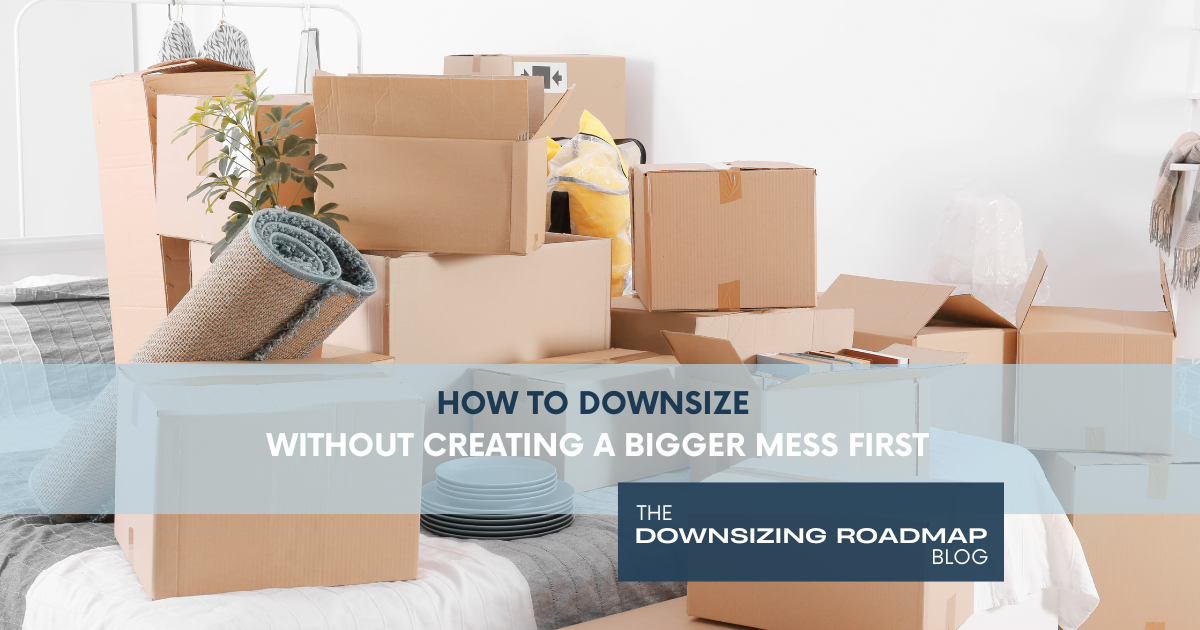
The way to downsize without making a mess is to work in contained, decision-based cycles that begin and finish in the same space, rather than opening up multiple areas at once.
Most people assume that downsizing will naturally feel worse before it feels better. However, in many cases, that experience is not caused by the amount of belongings. Instead, it is the result of starting without a clear structure for how decisions will be made and completed.
When there is no structure, items begin to spread into surrounding spaces, and what started as a focused effort turns into several partially completed areas. As a result, the home can begin to feel more difficult to live in, which often slows progress or stops it altogether.
Why Does Downsizing Feel Messy Before It Gets Better?
Downsizing tends to feel messy when too many decisions are open at the same time.
For example, someone may begin in a closet, then shift to a drawer, and later open boxes stored in another part of the home. While each step feels productive in the moment, the overall result is that nothing has been fully completed.
Because of this, there is little visible progress, decisions begin to stack up, and the environment itself starts to feel unsettled. In addition, it becomes harder to pick back up where you left off, since multiple spaces now require attention.
In other words, the challenge is not effort. It is the absence of a clear order.
How Do You Downsize Without Making a Bigger Mess?
To downsize without making a bigger mess, three strategies need to work together: containment, decision batching, and a closed-loop process. When these are used consistently, the process remains manageable and your home stays functional while you work through decisions.
Containment: Keep the Work Physically Controlled
Containment means limiting how much is actively being sorted at one time.
Rather than emptying an entire room, you choose a defined space such as one drawer, one shelf, or one specific category within a room. Everything stays within that boundary until decisions are complete.
This approach allows you to maintain a livable environment while still making progress. In addition, it creates a clear start and finish point for each session, which makes it easier to return and continue.
Decision Batching: Make Similar Decisions Together
Decision batching reduces mental fatigue by keeping you focused on one type of decision at a time.
For example, instead of alternating between paperwork, kitchen items, and sentimental belongings, you would work through a single category in one session. As a result, your thinking stays consistent, and decisions become easier to make.
Over time, this reduces the tendency to stall, because you are no longer constantly shifting between different types of emotional and practical decisions.
Closed-Loop Downsizing: Finish Each Step Before Moving On
A closed-loop process means that every downsizing session includes both sorting and completing the next step for those items.
For example, items that are being donated are placed into a bag and moved to a designated location. Trash is removed from the home, and items you are keeping are returned to an organized space.
Nothing is left in temporary piles.
By completing the full cycle each time, your home resets at the end of each session. Therefore, instead of accumulating unfinished decisions, you build steady, visible progress.
Where Should You Start to Avoid Creating Chaos?
If your goal is to downsize without making a mess, it is important to begin in a space where decisions are more straightforward.
In many cases, this includes areas such as a bathroom cabinet, a linen closet, or a single kitchen drawer. These spaces tend to carry less emotional weight, which allows you to practice the process before moving into more difficult categories.
In addition, completing a smaller space from start to finish provides visible progress, which makes it easier to continue with confidence.
How This Fits Into a Clear Downsizing Plan
These strategies are most effective when they are part of a larger, structured plan.
Within the Downsizing Roadmap Method, this stage falls into the Decide It phase, where you are making clear and confident decisions about what stays and what goes. However, those decisions become significantly easier when they follow the earlier step of getting clear on where you are going next.
Without that context, even simple decisions can feel heavier than expected. With it, the process becomes more focused and easier to move through.
You can explore more about how the full process works here:
https://downsizingroadmap.com/
Frequently Asked Questions About Downsizing Without Making a Mess
Is it normal for downsizing to feel messy at first?
It can feel slightly unsettled at times, but it should not take over your home. When multiple areas are open at once, it is usually a sign that the process needs more structure.
How long should a downsizing session be?
Most people make better progress in focused sessions of one to two hours. This allows enough time to complete a full cycle without leaving items unfinished.
What if I cannot finish everything in one session?
In that case, the scope is likely too large. Reducing the size of the area makes it possible to complete the process, including the closed loop, before stopping.
How do I avoid creating piles I have to deal with later?
Avoid setting items aside without a clear next step. Each item should either be returned to its place, removed from the home, or assigned a defined next action before moving on.
What is the most common mistake when starting to downsize?
Trying to work in too many areas at once. This creates more decisions than can be completed, which leads to overwhelm and stalled progress.
A Better Way to Move Forward
Downsizing does not need to disrupt your entire home in order to move forward.
When you work within contained spaces, group similar decisions together, and complete each step before moving on, the process becomes more manageable and easier to sustain. As a result, progress builds in a way that feels steady rather than overwhelming.
If you’re thinking about downsizing and want a clear place to start, you can begin with our Free Downsizing Guide:
https://downsizingroadmap.com/guide/
If you prefer to learn by listening, you can explore The Downsizing Roadmap Podcast:
https://downsizingroadmap.com/downsizing-roadmap-podcast/
We share ongoing insights on our Facebook page:
https://www.facebook.com/downsizingroadmap/
You’re also welcome inside our private Facebook group, Downsizing & Decluttering Community | Simplify Your Next Chapter, where people ask questions and share experiences:
https://www.facebook.com/groups/456269625127772
And if you’re ready to talk through your situation, reach out here:
https://downsizingroadmap.com/help/
Jodi Rosko and Heather Fisher work with clients every day to help them move through downsizing with a clear plan, so progress can happen without creating more stress along the way.