
Keeping memories and storing guilt can look identical from the outside. They lead to two very different feelings once the boxes are open. Keeping memories means choosing a few meaningful items you can see, use, or share. These are the pieces that bring a story back every time you notice them. Storing guilt looks like something else entirely: totes in the garage, untouched for years, full of a loved one’s things. You’ve kept them because letting go of the object feels like letting go of the person.
The good news is that you can keep the person without keeping everything they owned. That’s the shift we want to walk through with you today.
Why Do Sentimental Items Feel So Hard to Let Go Of?
Most people don’t struggle with the memory itself. They struggle with the volume attached to it. A parent’s home might hold forty years of birthday cards, holiday decorations, and half-finished hobbies. Somewhere inside all of that sits the handful of items that tell their story.
When everything feels important, nothing gets decided, and that hesitation is where storing guilt usually starts. A box left unopened for a decade was never really a choice, just a decision nobody got around to making.
Here’s a question worth sitting with. If you could only keep five things that captured who this person was, what would you choose? That question alone tends to separate the meaningful from the merely present.
What Does Storing Guilt Look Like?
A closet nobody opens, a storage unit paid for month after month, a garage where the car hasn’t fit in years. These are the more common shapes storing guilt takes, long before anyone calls it that. Ask what’s inside, and the answer is often something like this. Just stuff from my mom’s house, not totally sure what all is in there.
That uncertainty is the clearest sign. When you can’t name what you own, you’re not preserving a memory. You’re preserving an obligation instead. The story gets buried under the sheer amount of stuff. Rather than feeling connected to the person, you end up feeling weighed down by their belongings.
Keeping memories works in the opposite direction. It starts with knowing exactly what you have and why it matters. Then it means keeping it somewhere you’ll see it.
How Do You Turn a Box of Memories Into Something You Can Display?
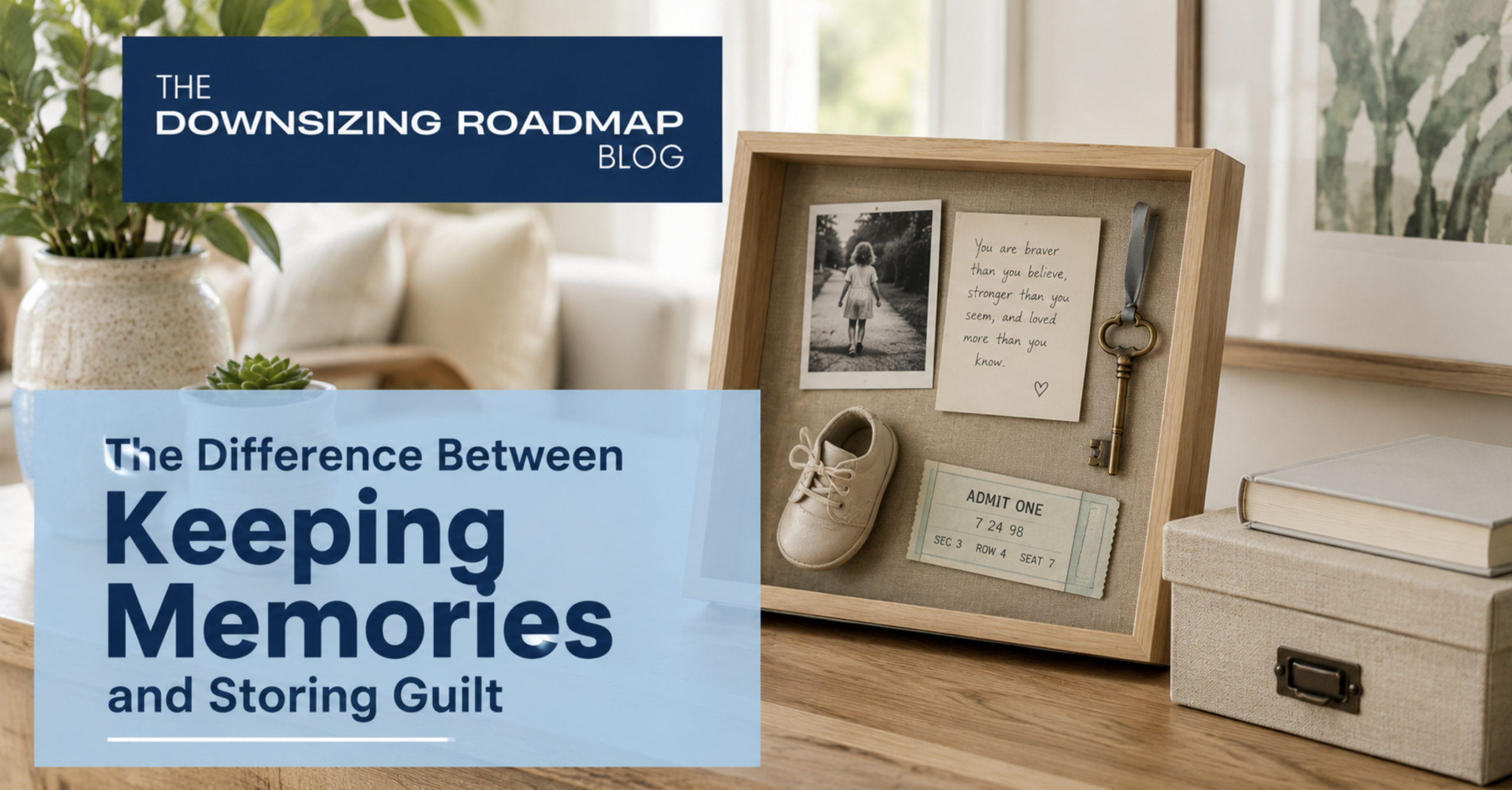
We have seen wonderful examples of reducing the bulk while honoring memories in our own families. Jodi’s family wanted to preserve the legacy of a grandfather’s hobby of tying fishing flies. They did not need to keep the entire workshop of feathers, hooks, spools of thread, and half-finished projects. So they pulled out the flies that were the most treasured and mounted them in a shadowbox. The rest of the supplies went to someone who could use them. Left in the workshop, all of the supplies would have just been more storing guilt, taking up space nobody visits. Now the shadowbox hangs on the wall, and Jodi’s family tells the grandfather’s story every time someone asks about it.
That same idea works for almost anything. A collection of handwritten recipe cards can become one small book of the recipes made and loved. That’s a lot lighter than a box of cards nobody can read anymore. A parent’s overflowing tool collection can shrink down to the single hammer or wrench someone still reaches for. The rest can go to a neighbor who will use it.
The pattern holds steady every time. You’re not choosing between keeping everything and keeping nothing. You’re choosing the version of the memory that brings you joy every time you see it.
How Do You Stop Storing Guilt and Start Keeping the Story?
If you’re standing in front of boxes you haven’t opened in years, start smaller than you think you need to. Pick one box, not the whole garage. Sort what’s inside into three piles. Keep the story pieces, release the duplicates, and set the unsure pieces aside for later.
Move quickly through the first two piles. The story pieces get set aside for display or safekeeping. Supplies and duplicates get donated, sold, or passed along to someone who can use them. Give yourself permission to let go of quantity, since the story was never about how much you kept in the first place.
The unsure pile can wait a little longer, but not forever. Set a date, even a loose one, to make a final call. Storing guilt often grows inside that unsure pile, since it never gets revisited. A memory you can see and share is worth more than one buried under everything else that came with it.
You get to decide what stays visible in your life. That’s not letting go of the person. That’s making room for their story to be told.
If you’d like a simple framework for working through a home room by room, our Free Downsizing Guide can help. It walks through exactly how to stop storing guilt for good. We also share stories like this one, including more about that shadowbox, on our Facebook page.
Frequently Asked Questions About Keeping Memories, Not Storing Guilt
How do I decide what to keep when everything feels important?
Start with the story, not the object. Ask what this item represents, then keep the pieces that carry that story most clearly. The rest can go without taking the memory with it.
Is it wrong to get rid of things that belonged to someone I loved?
Not at all. Letting go of an object doesn’t mean letting go of the person. Keeping less often makes the memory easier to see and share, not harder.
What if I don’t remember the story behind an item anymore?
That’s useful information on its own. If you can’t recall why something mattered, it probably belongs in the release pile, not the display pile.
How many keepsakes are too many?
There’s no set number to aim for. A better test is whether you can see, use, or share what you’ve kept. If it’s boxed and forgotten, that’s storing guilt, not a keepsake.
If you’re thinking about downsizing and want a clear place to start, you can begin with our Free Downsizing Guide:
https://downsizingroadmap.com/guide/
If you prefer to learn by listening, you can explore The Downsizing Roadmap Podcast:
https://downsizingroadmap.com/downsizing-roadmap-podcast/
We share ongoing insights on our Facebook page:
https://www.facebook.com/downsizingroadmap/
You’re also welcome inside our private Facebook group, Downsizing & Decluttering for You or Your Parents | Downsizing Roadmap, where people ask questions and share experiences:
https://www.facebook.com/groups/downsizingroadmapcommunity
And if you’re ready to talk through your situation, reach out here:
https://downsizingroadmap.com/help/
Jodi Rosko and Heather Fisher and Downsizing Roadmap work with clients every day to help them move through downsizing with a clear plan, so progress can happen without creating more stress along the way.